Key Takeaways
Emergency vehicles use a combination of audio and visual alerts to demand control of the road or scene. Police sirens and police emergency lighting are great examples, both integral parts of the warning system used in cruisers. How are the two integrated to ensure effective communication? D&R Electronics Co. Ltd., a major fleet vehicle solutions provider in Bolton, Ontario, explores all this and more in this blog.
Why Integrated Police Sirens and Emergency Vehicle Lights Matter?
The Importance of Audible and Visual Warning Systems
The combination of audible and visual warning systems is critical for police cruisers and all emergency vehicles, as visual warnings provide instant line-of-sight awareness at the speed of light. In contrast, audible warnings bypass physical blind spots and obstructions by diffracting around corners into the human ear, enabling better communication.
Improving Emergency Response Effectiveness
The combination is effective at clearly grabbing attention and improving emergency response times for first responders by giving them the right of way in heavy traffic environments. This is why modern emergency fleets depend on reliable police sirens to complement visual warning systems during an emergency response.
Enhancing Road User Awareness
In instances where the road user is not aware of the lights or the regular siren sound, the combination is sure to grab their attention.
Supporting Officer and Public Safety
Lastly, it supports officer safety and operational efficiency in the emergency vehicle and provides public safety.
Understanding How Integrated Warning Systems Work
The Relationship between Sirens and Emergency Lighting
Sirens and emergency lighting function as a dual sensory warning system for motorists and pedestrians on the road. While the former provides visual cues over long distances, the latter helps other drivers assess the location of the emergency vehicles along turns and blind spots.
Synchronizing Audible And Visual Alerts
While both work effectively together, synchronizing them makes operation faster and easier. This is typically done by unified control panels with programmable multifunction buttons that turn on specific siren tones and flash patterns on emergency lights at the push of a single button.
Controller Modules And System Communication
The control panels or modules enable the coordination of sound and light systems in an emergency vehicle to create coherent system communication.
Power Management And Electrical Integration
To bridge the gap between the digital controller modules and the physical siren and lighting systems, there is a need for effective power management. This monitors the car's battery voltage and efficiently controls the supply / cut’s-off power to emergency equipment and warning systems to avoid a dead car battery, which could disable the vehicle itself.
Speaker Placement And Sound Projection
Just like emergency lighting placement enhances visibility, speaker placement for police sirens increases sound projection and penetration. For optimal speaker placement, understanding core siren components goes a long way.
Key Components of an Integrated Emergency Warning System
Police Light and Siren Control Systems
The police light and siren control system is the command processing center of the light and siren system. It encompasses microprocessors, amplifiers, tone generators, etc. It receives the input, processes it, and generates an action for the relevant hardware output. E.g. tells the lights to play a certain flash pattern or picks up the right siren tone and sends it through the amplifier to the siren speakers; all this can be done with a push of a single programmable button.
Speaker Assemblies
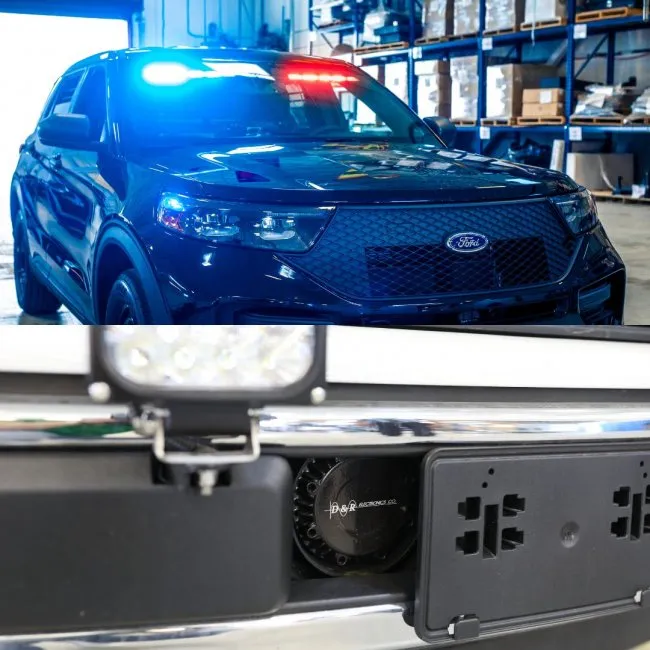
Speaker assemblies are mounted externally on the vehicle. Behind the grille or the push bumper of the car is the most common mounting area. They allow projection of the siren tone across long distances. 11 ohms impedance and a 100 Watt speaker are the minimum acceptable ratings for an emergency vehicle speaker.
LED Emergency Lighting
LED emergency lighting is the major visual communication system in emergency vehicles. Manufactured in the form of lightbars or beacons, they provide 360-degree visibility under all weather conditions. Modern LED emergency vehicle lights are designed to work seamlessly with integrated warning systems.
Controller and User Interface
A controller is the programmable user interface used to enable a task or a combination of tasks at the press of a button. E.g., a single programmed master emergency button can turn on a Lightbar, perimeter lights, and a siren tone (wail), or a combination of the gunlock button and any other key can be programmed to open a gun box. The controllers can also be used for toggling between different lighting patterns or siren tones, or activating pre-programmed alerts or notifications.
Vehicle Wiring And Power Distribution
Vehicle wiring is the infrastructure that connects the siren and emergency lighting system in emergency vehicles. Power distribution systems allow efficient power transfer between different components.
Mounting Hardware and Synchronization Modules
Mounting hardware is the last part of an integrated emergency warning system. They secure the light bars and siren speakers onto the emergency vehicles.
Benefits Of Integrating Police Sirens With Emergency Vehicle Lights
Faster Recognition By Motorists
The main purpose of an integrated emergency warning system is faster recognition by motorists. Either lights, sirens, or a combination of both will succeed in grabbing the attention of motorists, irrespective of the environment or weather conditions. It notifies more than one faculty of the human sensory system.
Improved Situational Awareness
Motorists also experience improved situational awareness with an integrated police siren and lighting system. Consequently, it helps them to slow down their vehicle, take a diversion, or provide the right of way for the emergency vehicle as the situation demands.
Simplified Vehicle Operation
By integrating both siren and lighting systems, it simplifies the first responders' operation, increasing efficiency. They can now activate both at the click of a button and effortlessly toggle between different functions according to the situation.
Better Coordination During Emergency Response
Integration not only helps motorists, but it also helps improve coordination between other first responder vehicles. Through audio and visual signals, they can coordinate effectively during a crisis, improving response times and effectiveness.
Reduced Installation Complexity
From an installation standpoint, integrating sirens with emergency vehicle LED lights is a major plus. Less wiring and related hardware saves space and makes installation and maintenance way easier. Consolidated and structured cable management makes installation and maintenance way easier.
Improved Fleet Standardization
A fleet is only as effective as its weakest link. Integrating light and sound systems in emergency vehicles is a move towards better fleet standardization, which is a major plus in the long term.
Choosing The Right Integrated System For Your Fleet
Identify Operational Requirements
What are the mission-critical requirements of your specific operation? For instance, lighting and siren systems for law enforcement fleets will differentiate significantly from utility fleets.
Match Equipment To Vehicle Type
What are the vehicle types used in your fleet? This is a key consideration as it is necessary to find equipment that is compatible with the vehicle type. This is also important as it requires a custom design, detailed wiring diagram, and layout plan.
Evaluate Siren Output And Speaker Performance
In terms of the siren, there are two options: a standard siren output and/or a low-frequency siren. Single sirens or dual sirens with or without low-frequency output are options to consider; fleet managers should review detailed police siren selection criteria before investing in integrated warning systems.
Select Compatible Lighting Systems
Light systems meeting the vehicle's role in the fleet are an important consideration example, if the vehicle is earmarked for undercover operations, only the discrete lighting will be used. Emergency vehicles' lighting needs to meet SAE Class 1 certification. Meaning it must be seen in bright sunlight from at least 50 meters and involves bright light sources, well-engineered optics, and lenses. Other factors to consider include beam intensity and visibility across oblique angles. Moreover, compliance requirements must also be considered.
Consider Expandability And Future Upgrades
Lastly, the integration must be compatible with future upgrades to continue constant optimization if required.
Installation Best Practices For Integrated Systems
Planning Equipment Layout
Planning equipment layout is an excellent installation practice as it ensures optimal placement of key equipment and wiring for safe and effective operation.
Optimizing Speaker Placement
Since the speaker is solely responsible for the projection of siren sound, its placement takes precedence. They should be installed in locations where it is most likely to project sound the farthest, such as the bumper of the grille, without compromising the vehicle’s structural integrity.
Routing Wiring Safely
The wiring is an integral part of lighting and siren systems, as they connect all parts and transfers power to the required components effectively. Hence, routing them safely is vital as it ensures reliable power and prevents electrical overloads.
Testing Synchronized Operation
Once all the components are connected to the central module, a multi-point functional test is conducted to check the performance of sirens, LED strobe lights, flash patterns, and more.
Common Challenges And How To Overcome Them
Limited Mounting Space
Limited mounting space can impact the performance of key equipment. For instance, if the mounting of police siren speakers is obstructed, it can impact the sound of the sirens in high-traffic urban environments.
Electrical Load Management
Poor wiring or power management can lead to a dead power source, crippling the vehicle itself. Shorting or overload can cause damage to vital equipment.
Equipment Overcomplication
For first responders and emergency vehicle officers, providing simplicity of operation during high-pressure situations is a must so they can focus on the job at hand. Rather than figuring out complex emergency equipment. Programming complex scenarios to be activated by a simple single button press does the job. And frees the first responder to do theirs.
Conclusion: Building Safer Emergency Response Vehicles
To learn more about the integration of police sirens and lighting, and the role of first responder LED lights in improving emergency vehicle visibility and safety, reach out to us at D&R Electronics Co. Ltd.
As a leading fleet solution provider in North America, the Middle East, Europe, and Australia, we offer a variety of solutions ranging from LED beacons and police sirens to emergency vehicle LED lights and more. Contact us at 1-800-538-7338 for more information.
FAQs
Why are police sirens integrated with emergency vehicle lights?
Police sirens are integrated with emergency vehicle lights to create a multi-sensory warning system. This system engages both sight and sound, leading to a drastic reduction in driver reaction times in heavy traffic or low visibility conditions.
Can sirens and emergency lights be controlled together?
Yes, sirens and emergency lights can be controlled together via a controller module.
What components are required for an integrated warning system?
The core components required for an integrated warning system include a control head, siren amplifier, warning lights, speakers, wiring, and power distribution module.
How do integrated systems improve emergency response?
Integrated systems improve emergency response by clearing traffic faster and reducing instances of collision.
What should fleet managers consider when upgrading warning systems?
Fleet managers must consider safety regulations, vehicle power capacity, lighting synchronization, and more while upgrading warning systems in vehicle fleets.





 Find a Dealer