The most prevalent challenges faced by police sirens in high-traffic urban environments include high ambient noise, poor sound penetration, and poor sound localization attributed to concrete structures with narrow roadways causing wind tunnels, which in turn affect sound waves primarily through refraction (bending), attenuation (damping), and scattering caused by high-velocity airflow and turbulence. This can jeopardize the safety of law enforcement personnel in their vehicles as well as other motorists and pedestrians. In this blog, D&R Electronics Co. Ltd., a major fleet vehicle solutions provider in Bolton, Ontario, explores these challenges and showcases how low-frequency siren add-ons can mitigate them effectively.
What Are the Shortcomings of Police Sirens in High-Traffic Environments?
High Ambient Noise
High-traffic urban environments emanate a variety of noises in the form of horns from other vehicles, radios, and air conditioning systems in vehicles with the windows rolled up. Moreover, the introduction of cell phones has further complicated the matter. All these noises make it a challenge for police sirens to grab the attention of motorists or pedestrians quickly.
Poor Sound Penetration
Modern vehicles are designed to provide high sound insulation. Some models even include noise-cancelling features. Among pedestrians, too, the usage of noise-cancelling earphones is not uncommon. This poses a unique challenge for law enforcement vehicles to direct attention on time through sirens. These compounds the existing challenges of sound not being able to penetrate through concrete barriers and steel reinforced structures. This poses a severe safety hazard to both officers and motorists/pedestrians.
Poor Sound Localization
Even without extensive insulation, drivers might struggle to find exactly where the police siren sound is coming from immediately. This is because of refraction (bending), attenuation (damping), and scattering of sound waves by environmental conditions. This consequently delays the driver’s reaction time and also causes a possible distraction while the driver searches for the source of the sound visually. In the case of an emergency vehicle, every second counts in saving a life.
How Low-Frequency Siren Add-Ons Address These Problems?
Greater Penetration
Low-frequency police siren for cars generates deep penetrating tones with low pitch, long wavelength, few cycles per second, having a thundering effect, which allows the sound to travel farther and to penetrate obstacles more effectively and bend (diffract) around barriers. Thus, they can be very effective in areas with high ambient noise.
Feel Factor
Aside from the sound itself, the low-frequency sound waves move a large amount of air due to the high acoustic energy with higher amplitude waves, which resonates in a similar frequency range of the human body parts, inducing a “feel factor” in people about the vicinity, including both motorists and pedestrians. This means that a passerby can sense the sound even through the car's sound protection insulation and earphones.
Conclusion
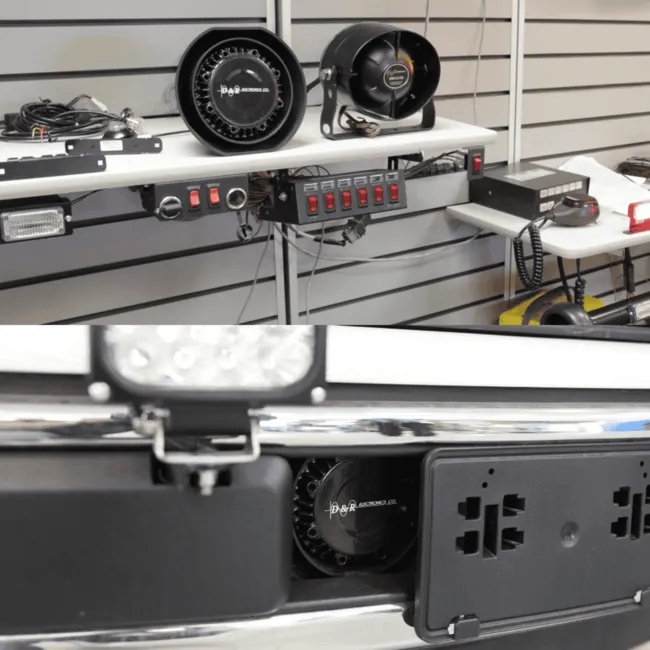
To conclude, a low-frequency police siren for cars, such as the Thunder siren add-on from D&R Electronics Co. Ltd., can mitigate the many challenges of conventional sirens in high-traffic urban areas.
To learn more about the technology, product range, specifications and more, contact us at 1-800-538-7338 today. As a reputed fleet vehicle solutions provider in North America, the Middle East, Europe, and Australia, our products are designed to improve performance and personnel safety.
FAQs:
Are the low-frequency sirens compatible with primary police sirens?
Yes, the low-frequency sirens are highly compatible with the main police siren, as it acts as an add-on.
What are the different sound patterns used in police sirens?
The different sound patterns used in police sirens include yelp, wail, Hi-lo, thunder, and stinger.





 Find a Dealer