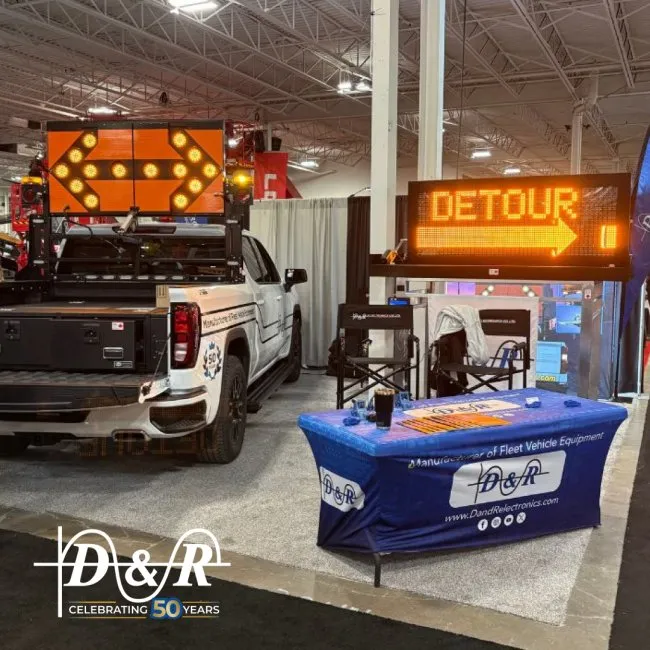
Traffic directors are an integral part of utility vehicles and emergency vehicles. These lights are mainly mounted on a vehicle to provide clear traffic direction from a minimum of 50 feet, even in the brightest sunlight. For Vehicles approaching from the rear of the directing vehicle. They exhibit flash patterns to draw attention, caution, and warn. Arrows to redirect the flow of traffic, and Verbal directives to emphasize the directive. In this blog, D&R Electronics Co. Ltd., a reputed fleet vehicle solutions provider in Bolton, Ontario, such as LED beacons, police sirens, vehicle storage cabinets and more, explores the functions and different flash patterns of traffic directors.
What Are The Key Functions Of Traffic Directors?
Safe Lane Merging
When an emergency vehicle is in the same lane ahead of other motorists and is blocking their field of view, the traffic directors flash left, right, or center-out arrows to alert the vehicle to move left or right. This enables the motorists to safely merge lanes as directed at a safe distance from the directing vehicle.
Slow/Stop Warnings
The traffic directors also flash steady burning lights or alternating flash patterns to alert other motorists behind to either slow down or completely stop. This is a common practice when emergency vehicles are at an incident scene in high-traffic areas.
Hazard Marking
The lights are also used to outline the contour of the vehicle, whether it is an ambulance, police cruiser, or a utility truck in low-visibility environments. This allows the motorists around the emergency vehicles to see them clearly and take necessary measures to avoid collisions.
What Are The Common Flash Patterns Used In Traffic Directors?
Left/Right/ Center Out Arrow
The purpose of these arrows is to allow other motorists to merge safely in other lanes to the left or right as directed by the direction the arrow indicates.
Center-Out
This pattern indicates that motorists on both sides of the emergency vehicle need to go around it. It is a common pattern that is used when the road ahead is blocked.
Warning/Alternating Light
This is used when the emergency vehicle is moving slowly across multiple lanes, and indicates that other motorists must proceed slowly with extreme caution.
Conclusion
To conclude, traffic directors are a key part of emergency vehicles as they ensure safety for motorists on the road and for the first responders themselves.
D&R Electronics Co. Ltd. is a leading fleet solution provider in North America, the Middle East, Europe, and Australia. We offer a variety of solutions ranging from LED beacons, vehicle storage cabinets, police sirens, and more. Contact us at 1-800-538-7338 for more details.
FAQs:
How do traffic directors differ from standard warning lights?
Standard warning lights warn other motorists of the presence of emergency vehicles, whereas traffic directors also direct motorists on which direction they must go.
Are traffic directors available in different colours?
Traffic directors use amber LEDs for arrows or lights directing traffic. However, law enforcement vehicles can have other colours like red, blue, and clear LEDs in their traffic directors. The red and blue will flash, identifying the vehicle as police or fire, and the white LEDS are used to flood the surrounding perimeter of the vehicle with strong white light, helping first responders and utility workers to do their job in a well-lit area. Message boards on traffic directors can use different color LEDs.





 Find a Dealer