Key Takeaways
Law enforcement vehicles store and operate vital equipment such as sirens, emergency vehicle LED lights, and more. Controlling them all through a centralized system is best for boosting performance and safety. This is where emergency vehicle consoles are used. In this blog, D&R Electronics Co. Ltd., a major fleet vehicle solutions provider in Bolton, Ontario, shares the best ways to choose emergency vehicle consoles.
Why Emergency Vehicle Consoles Matter In Law Enforcement Vehicles?
The Role Of A Vehicle Console In Daily Police Operations
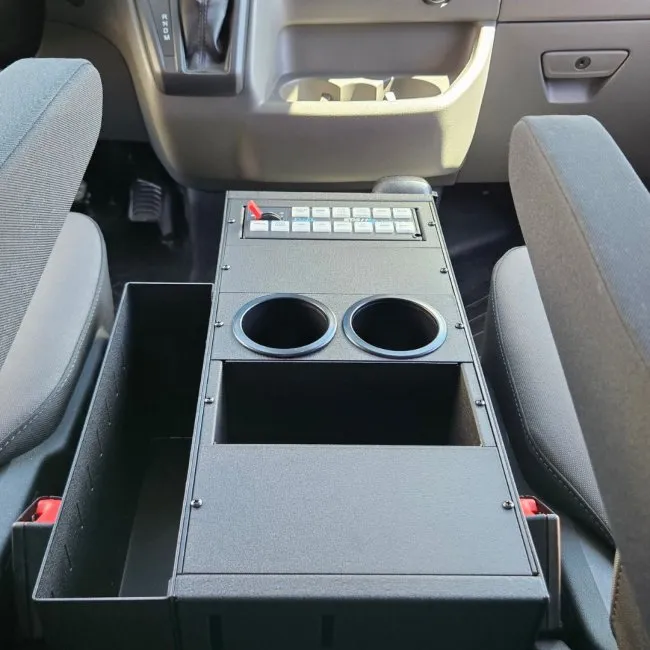
The vehicle console in an emergency vehicle can be considered a hub for different equipment. Its main purpose is to act as a central console for radios, sirens, and the lighting system used in emergency vehicles and utility fleets.
Supporting Officer Safety And Situational Awareness
In terms of law enforcement, emergency vehicle consoles help improve officer safety by providing easy access and control to major systems in the vehicle. This helps maintain their situational awareness and enables swift action when required.
Improving Equipment Organization And Accessibility
Without a central console, operations of emergency LED lights, sirens and other electronics can become challenging. Personnel can waste precious time accessing different equipment, thereby reducing efficiency. A console eliminates these concerns with swift equipment organization and accessibility.
Adapting To Evolving Fleet Technology
As fleet technology such as police sirens and lighting continues to adapt, the consoles will still be a relevant solution to organize and control it all in one spot.
Understanding The Core Components Of An Emergency Vehicle Console
Console Housing And Mounting System
The console housing and mounting system is a major part of emergency vehicle consoles. The former houses the space for storing various equipment such as control panels and radios, and the latter secures the entire console to the chassis of the vehicle for stability.
Equipment Faceplates And Mounting Brackets
Equipment faceplates and mounting brackets are solutions that allow upfitting of specific equipment to the console. It can be considered the physical base or structure of the console.
Control Panels And Switch Modules
The control panels and switch modules are designed to manage different equipment in the vehicle, such as emergency flashing lights, siren systems, lightbars and public address systems.
Cable Management And Power Distribution
Cable management and power distribution with respect to the console refers to the concealed fuses, gang blocks and power studs situated beneath the console that allow transfer of power to all necessary devices.
Key Factors To Consider When Choosing An Emergency Vehicle Console
Vehicle Make And Model Compatibility
The first factor to consider is the vehicle make and model. Compatibility is a major factor, and selecting the right emergency vehicle console starts with choosing a solution that matches the fleet vehicle, supports installed electronics, and allows room for future equipment upgrades.
Equipment Capacity And Expansion Requirements
Make sure that the various equipment, such as radios and control systems, properly fit within the console without pinching the cables to the vehicle floor. Furthermore, the emergency vehicle console should also have extra mounting space so that it can accommodate more equipment or upgrades in the future.
Ergonomics And Driver Accessibility
Ergonomics and driver accessibility are key parts of the discussion. The console must be mounted with angled faceplates in such a way that radios, as well as lighting and siren controls, are facing the driver for easy access and control.
Durability For Demanding Environments
Since law enforcement and emergency vehicles operate in demanding environments, the consoles must be designed for rugged applications without compromising on effectiveness.
Ease Of Installation And Maintenance
Lastly, also consider installation and maintenance. The console must be easy to install and maintain for easy serviceability.
Matching Console Design To Law Enforcement Applications
Patrol Vehicles
Patrol vehicles are the most common in law enforcement fleets. The console design here mainly features siren and lighting controllers, and a slanted design for easy access to the driver.
Traffic Enforcement Units
Traffic enforcement units are more focused on a constant influx and processing of data. Hence, the consoles are designed to majorly equip radar control units, plate recognition displays, and communication systems spanning multiple bands.
K-9 Vehicles
Consoles for K-9 vehicles are more designed around the safety and comfort of the K-9 units. As such, the consoles feature remote door openers or poppers, temperature controllers and alarms, and storage for accessories such as track leads.
Supervisory And Command Vehicles
These operate more as a mobile command center. As a result, the consoles are designed to be larger and more versatile. Examples of equipment used include routers, multiple radio heads, large monitor mounts, and heavy-duty switch panels.
Common Mistakes When Selecting Emergency Vehicle Consoles
Choosing Based On Current Needs Only
Emergency vehicle consoles, much like any equipment or upfit, must take future additions or upgrades into account. Otherwise, a complete overhaul might be required to accommodate new equipment.
Overlooking Equipment Compatibility
The equipment in the console must be compatible with the system. Precious resources and space can be wasted by adding equipment that is a poor fit to the console, reducing overall productivity on the road.
Ignoring Officer Ergonomics
Not only is this inefficient, but it is also highly dangerous. Poor accessibility and ergonomics can endanger law enforcement personnel on the road as they try to access the console.
Poor Cable Management Planning
Not managing cables properly can lead to pinching or damage, thereby affecting the function of key equipment in the vehicle.
Selecting Low-Quality Mounting Systems
Low-quality mounting systems can damage the consoles and the equipment, requiring a complete overhaul.
Step-by-Step Guide To Selecting The Right Console For Your Fleet
Step 1: Assess Operational Requirements
A proper assessment of the requirements of the fleet is the most obvious step. This will help determine which types of equipment should be given priority over others, how much space they will occupy, how their cables will be organized and much more.
Step 2: Inventory Existing Equipment
Take inventory of existing equipment in the fleet vehicle. Determine if they are meant to be mounted on the console, or if newer equipment will have a greater importance to be placed on the console.
Step 3: Evaluate Vehicle Cabin Space
Determine the cabin space in the vehicle, as it will decide the dimensions of the emergency vehicle console. If there is more cabin space and a requirement for easy access to a wide array of equipment, a bigger console can be considered.
Step 4: Plan Equipment Layout
Next, the step involves planning the layout of the equipment within the console itself. Based on importance, different equipment should get priority/proximity to the personnel for easy access.
Step 5: Verify Compatibility And Safety
Once the equipment is installed, check for operational compatibility and safety. Check if the personnel are able to easily access all equipment in the console.
Step 6: Standardize Across The Fleet
Ensuring smooth and effective operation, standardize the console and equipment across the entire fleet.
Conclusion: Selecting A Console That Supports Safer And More Efficient Fleet Operations
To conclude, choosing the right console for a specific vehicle and fleet operations is vital; it boosts productivity, reduces response time, and ensures personnel safety.
To learn more about emergency LED lights and which one is right for your fleet, contact us at D&R Electronics Co. Ltd. today. As a leading fleet solution provider in North America, the Middle East, Europe, and Australia, we offer a variety of solutions, including emergency vehicle LED lights, vehicle storage cabinets, emergency vehicle consoles, police sirens, perimeter lighting, and more. Contact us at 1-800-538-7338 for more details.
FAQs
What should an emergency vehicle console include?
An optimally designed emergency vehicle console should include communication systems, warning lights, audible signal controls, secure device mounts, a power distribution system, and ergonomic accessories.
How do I choose the right console for a police vehicle?
To choose the right console for a police vehicle, focus on vehicle-specific fit, officer ergonomics, and equipment capacity.
Are emergency vehicle consoles customizable?
Yes, emergency vehicle consoles are highly customizable, as they can be designed to accommodate specific requirements and preferences.
Can existing fleet equipment be installed in a new console?
Yes, existing fleet equipment can be installed in a new console. However, the physical mounting dimensions and power connections must be compatible.
How often should emergency vehicle consoles be inspected?
Emergency vehicle consoles should be inspected on a daily and weekly basis. The weekly inspection is catered towards functional checks.





 Find a Dealer